Imprint the Shift
Only drunken sailors get tattoos: My parents were wrong about that, and about a few other things that summer.

“Great,” she said. “We’ve now met our minority quota with your hiring.”
I looked up. “Minority quota?”
“Yes. You’re a woman.”
I was twenty-six, living in St Louis, signing postdoc paperwork at WUSTL, about to start at a centre studying how science teachers actually learn to teach. Five school districts, four museums, three universities, all of it funded to work out what happens when you ask a classroom to stop memorising and start inquiring. I had the K-2 group. I was going to bring the zoo into schools that had never had anything brought into them.
And I stumbled out of that office genuinely unable to work out what had just happened to me.
Two things were true and I could only hold one of them at a time. The first was that I had never once considered myself a minority, which tells you everything about my privilege: white, straight, middle class, educated to the eyeballs, raised in an intellectually and emotionally affluent house in 1980s London where the dinner table held gay couples and mixed-race couples and artists and unmarried mothers and blended families long before anyone was performing that on the internet. Nobody had ever handed me a category and made me stand in it.
The second was that of course I had lived it. From about eleven I stopped being a person and became a woman, whatever that was supposed to mean, and I got shouted at and groped and felt up like everyone else in a female body, and I dealt with it by spending my twenties in queer and BDSM spaces where consent and respect were the whole architecture, and by wearing trainers in straight clubs with my keys between my fingers and a rape alarm clipped to my jacket. I hadn’t thought of any of that as making me a minority. I’d thought of it as simply what being female in the world is, which is a considerably worse thing to have believed and took me years to notice I believed it.
So I did what I do. I went and researched sharks, because I’d just got certified to dive, and then big cats, and eventually I had a black jaguar inked across my lower back. Yes. A tramp stamp. I’m aware. Power and speed and something visceral that doesn’t ask permission, sitting on the part of my body that particular decade found most disposable.
Fuck that, I thought. I am not a goddamn minority.
That was appointment four or five. There have been about twenty-five now, across four countries, some of them multiple sittings for a single piece. The first was in London at sixteen and thoroughly illegal, after a summer at a German language school where I made my first international friendship with a woman who came to my fiftieth in London last week, and where we knotted bedsheets together to get out of the second-floor girls’ dormitory windows and go and drink Baileys with the boys. Learn from me: you need considerably more knots to get back up than you needed to get down. My parents’ verdict was that only drunken sailors get tattoos.
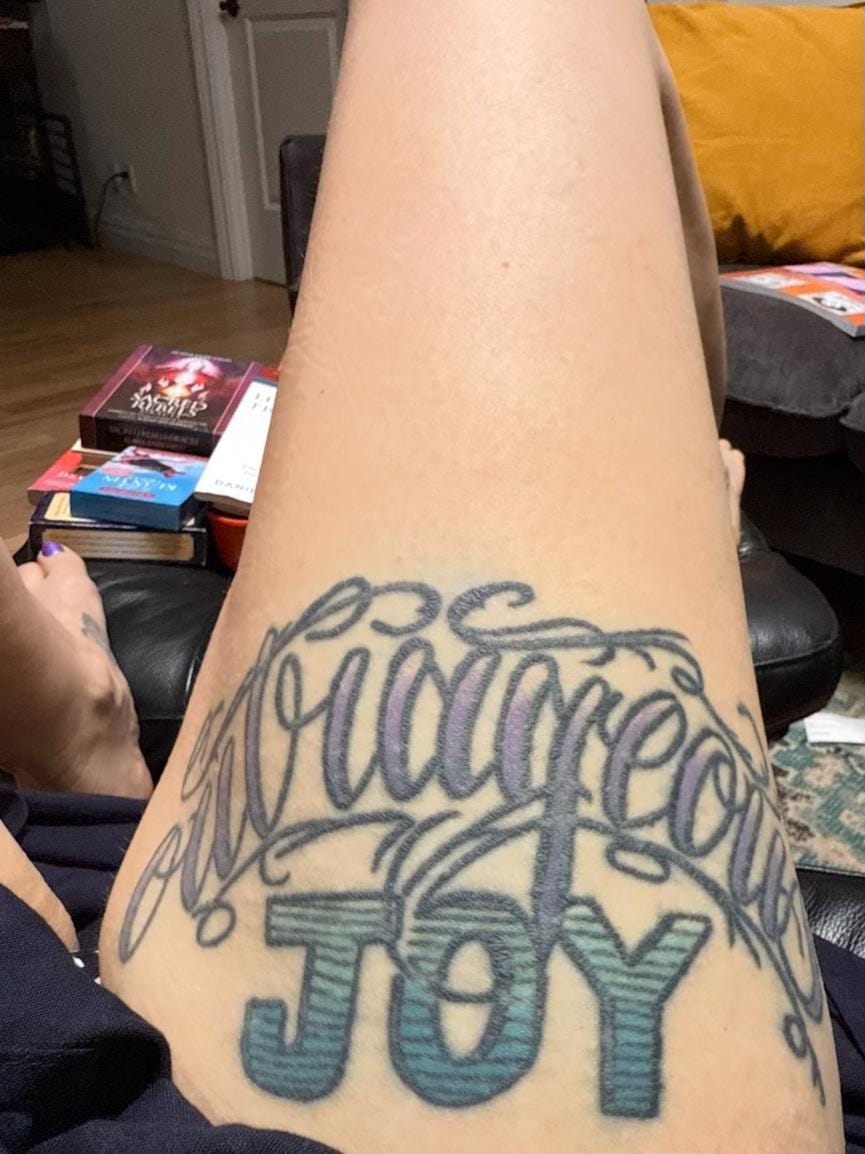
Every one since has marked a shift. A blue lotus, laid over my first three small ones, when my middle son hit three or four years past cancer, because a lotus comes up out of mud and silt and turns into that (and yes, it is a flower, I checked). Gratitude on my inner wrist for my grandmother, who came through abuse and abandonment and nursing through the war and six lost pregnancies and never stopped counting her blessings, because that was her entire method and she was the most loving person I have known. An anchor on my left ribcage after my ex-husband walked out for the fourth and final time on the first of July 2014, though first I bought a silver anchor necklace that afternoon and wore it for eighteen months until the divorce closed, and the question it asks me is which people and which ideas and which places I’m choosing to anchor to. Fall seven, rise eight. Moksha across the arch of my left foot, when I started actually living the freedom I’d been coaching other people towards. Outrageous joy on my right thigh, facing inwards, positioned so that I read it every single morning when I have my first pee.
That last one is the one that gives the game away.
Here is what the lab taught me that I did not properly understand until I’d lived it. The reactive system is fast, cheap and always running. You don’t get a vote on it. The intentional system is slower, more expensive, and it loses to the reactive one almost every time unless the environment has been rigged in its favour before the moment arrives.
Which is why insight, on its own, is close to worthless.
Gollwitzer’s work on implementation intentions is the cleanest evidence I know of here: forming a specific if-then plan tied to a cue in the environment produces substantially better follow-through than holding the goal in your head, with effects that hold across ninety-odd studies. The goal was never the problem. The problem is that a goal lives in the intentional system, and Monday morning belongs to the reactive one.
Outrageous joy facing me at six in the morning is a cue with perfect adherence. No app, no reminder, no willpower, no negotiation with myself about whether today counts. If I am standing here, then I am asking how I put outrageous joy into today and into everyone I meet. The ink isn’t the change. The ink is the cue, and the change is what the cue triggers, daily, for years, which takes far longer than anyone tells you: the median in Lally’s work is around sixty-six days, with people ranging from eighteen days to two hundred and fifty-four. Not twenty-one. Never twenty-one.
My doctoral thesis was called Intention and Reactivity, and I went after the relationship between those two systems with pupil dilation and reaction time and EEG. Thirty years on, it is still the only thing I work on.
So the question after any realisation is not “do we all agree.” It is: what did we change, physically, before we left the room?
You have insights constantly. The offsite where somebody finally said the true thing. The 360 that stung for a fortnight. The board meeting that went sideways and told you something you already half knew about your COO. The coaching session where you heard yourself say the sentence you’d been avoiding for a year.
And then Monday, and nothing in your building is different.
The insight was real. It just had nowhere to live. Culture is the set of things people repeat, including when nobody is watching, so a realisation that never becomes a repeated action never becomes culture at all: it becomes an anecdote about a nice offsite, and it goes into the same drawer as last year’s. Your team has watched this happen before. The ones who were waiting to see whether anything would actually change have stopped waiting, and one of them updated her LinkedIn photo last month, and you have not noticed yet.
So: within twenty-four hours of any real insight, change one thing in your environment that you cannot easily undo.
Not a plan, not a document, not a resolution. Something physical or something scheduled. The gym bag goes by the back door tonight, not tomorrow. The message goes to your EA now, while you still feel it, changing the standing agenda so every Monday opens with two minutes of silence and space to say something that isn’t a status update. Whatever the insight was, find its cue and put it somewhere you cannot avoid walking past.
I did it at eight, learning chopsticks. I’m doing it at fifty, learning guitar and learning to run my business through Claude. I did it in St Louis at twenty-six with a jaguar, because a stranger handed me a category and I wanted my body to argue back.
Imprint the shift. Immediately, while it’s hot, in a form you can’t negotiate with later.
The most recent one was April. When Jamie was two, in his first week in hospital for the cancer, watching Scooby Doo on repeat, I said what I always said, which was I love you to the moon and back, Jamie. And he said, I love you to the moon and back and monster truck, mom. We have said it to each other every year since, and to his brother and sister, for nearly eighteen years. For his twentieth birthday I had a moon and a monster truck and I love you put on my body, and he came with me.
Journal prompt
What did you decide six months ago that you still haven’t imprinted, and who on your team has already worked out that you didn’t?
One thing
Reply and tell me the one thing you moved, sent, or booked in the twenty-four hours after reading this. I read every one.
When I was 20 years old I had a moment of clarity in a crack house. I knew that if I didn’t get up and get out of there RIGHT THEN, my life would never be about anything but drugs and prostitution. I grabbed my jacket and walked out the door.
I have zero doubt that that moment, profound as it was for me, would have lasted about two weeks on its own. A casual drink would have led to a drug and I’d have been back at it.
By a miracle, I was taken to a 12-step meeting that night on a first date. I got a 24-hour coin and started working the program: I went to meetings, got a sponsor, and changed everything about how I live my life. August 9, 2026 it will be 32 years since I’ve had a drink or a drug (or turned a trick).
I didn’t know about implementation intentions. But I stumbled on that same idea organically. Moments of clarity pass, no matter how deep, no matter how impactful. Its actions and environments that change things.
Thank you for this gorgeous essay. I don’t know how I manage to not have any ink on my body but I love hearing how you’ve done yours.
And you may remember that OUTRAGEOUS JOY is a phrase I use and a big deal in my life and the fact that you have that tattooed on your thigh blows my mind. And is so hot! 🔥
Tamsin, this is a masterclass in turning raw human experience—from the sting of absurd corporate categories to the sacred weight of family survival—into living, breathing intentionality. Your frame on implementation intentions is spot-on; insight without an environmental anchor is just a fleeting ghost, but tying a shift to a physical, non-negotiable cue changes everything. As for your prompt on the one thing: six months ago, stepping into my own radical sabbatical, I decided to permanently cast aside the traditional corporate noise to anchor my work entirely in conscious, human-centered leadership—yet I caught myself letting legacy operational urgency creep back into the quiet space. So, within twenty-four hours of reading your piece, I moved: I permanently scrubbed the opening "status updates" off our future leadership calendar and booked a mandatory, unerasable 15-minute block of pure intentional silence at the start of every Monday agenda, ensuring the old reactive velocity can never reclaim the room.